I brought many of my maker projects to the Rochester Maker Faire in November. Many of these projects are described in previous posts for the curious.
Things went great overall. I always learning a lot watching people interact with these gadgets. That learning powers revisions for the next event. That will be the Syracuse Maker Faire in May and then it all gets packed up because I’m moving out of the region to crash other people’s Faires 🙂
When DFRobot released an inexpensive sensor with integrated face and gesture recognition for 5 distinct gesture for some reason my mind immediately went to the 5 gesture and tone sequence used as a greeting by aliens in the movie Close Encounters of the Third Kind. Throw in the 5 colors that went with the 5 tones and suddenly I really needed to re-create key elements from the movie props, especially the big light board in the final sequence. But I clearly would need to scale things down.
I decided a board of about 18 inches on a side would be the biggest that would fit in my small car along with an 8 foot stand and all the other stuff I typically take to maker showcase events.
I knew keeping the light board as light weight as possible would be critical to keeping the stand light without becoming tippy or needing heavy sandbags. Reviewing the movie it looks like they built big wooden boxes with big lights in them and put colored gels over the front. My ultralight version was to build the boxes out of black foam core board and include a white diffusion layer between the light sources and the color gels.
After a lot of thickened super glue and a lot of foam core & gel cutting the boxes came together. My big mistake in process was to allow finger prints to get on the gels before permanently gluing them down with super glue. I came back an hour later to find finger prints and smudges all over the inside of the gels like a scene from CSI. I managed to get the last one on in cleaner fashion by thoroughly cleaning it with alcohol first and wearing rubber gloves while mounting it.
For the light sources I used a series of 1 watt LED stars. These presented a challenge as they, and their resistors, could get hot yet they were glued to meltable foam core. Some aluminum flashing and extensive use of aluminum tape in between provided adequate heat barriers while staying light and even reflecting some light forward.
Electronics was generally not complicated on this since the most demanding logic (for face and gesture recognition) was already embedded in the sensor/camera combo semi-hidden in the front of the box. The electronics in the back panel mostly consist of an Arduino, an MP3 player/amp/speaker for the audio, and a bank of relays to sequence the light boxes. I tried using rotary encoders to adjust volume and recognition sensitivity but it turned out that the little Ardunio could just not keep up with the encoders. I’ll be swapping these out for something more analog in the near future.
When its up an running the unit detects the presence of a person, turns on the panel showing the 5 gestures, responds to the gestures with light and sound from the movie, and then rewards the correct sequence of gestures with the hello sequence from the movie.
Trying this out on live people at the recent Rochester Maker Faire, it became apparent that some changes are needed. It’s operation is bit obscure. People look up at it when the green gesture panel comes on, but don’t recognize that it is inviting them to make the gestures. I think I will add a new extension to that panel giving some instruction. I also need to change out the rotary encoders and maybe make it louder.
A item made the rounds on the maker media about a DIY self-ordering sales kiosk. This was for actually selling stuff. That did not seem nearly ambitious enough, and possessing an old tablet and knowledge of receipt printers, I knew I had to make something much more ridiculous.
The BougieVend is one of those project that starts out as “I can knock this out in a couple weeks” (don’t they all) and turns out to be considerably more effort.
Thanks to AI, creating the graphics for the interface was doable and rather fun once I made up my list of things you would never actually buy at at a self-ordering kiosk.
The brick wall was doing the programming in App Inventor (the only Android programming environment I have experience with) and getting it to work with the receipt printer. I think visual block programing is a really bad idea all around. If someone is old enough to read they will be much more efficient with text programming and all the shapes and bright colors just make it harder to fit code on screen, keep track of it, and nearly impossible to copy it. But I struggled through, wishing for Python.
I originally planned to have the tablet connected to the printer over the OTG USB cable. After a week of banging my head against a wall trying to get it to work I had to develop a plan B using a BLE connection, which worked once I got a different, and bigger, printer. Fortunately I have a use for the first one.
I also imagined building this all into a kiosk or point-of-sale terminal. However just holding the tablet with the printer next to it worked fine and was easier to transport and store.
The user enters their name and makes a series of selections on the tablet. They print out the receipt that lists everything they bought along with a lengthy series of up charges. People like to run their receipts into the billions and take them to boast to others. Of course there is always one in a crowd that just buys a single blade of grass because they don’t want to spend too much.
I discovered something interesting when showing this. If the tablet is just laying on the table along with other maker gadgets people invariably pass over it without paying attention. I tried putting it on a small temporary stand and suddenly people were interested in it. I don’t think I will go the full kiosk route but clearly I need to get it up off the table and more into the attention zone for future shows.
I’ve been around long enough to have used text-only computer terminals attached to mini-computers for work and fun. There are a number of re-creations of vintage computers and terminals around so I thought I would try my hand at something Raspberry Pi powered.
I started going the cyberdeck route and ended up using the chassis and keyboard of an early generation “laptop” (original weight 10 lbs.) with a new screen and the Pi. I made up a little text adventure game for people to play on it at events. It was popular enough but the keyboard was just worn out and kept failing.
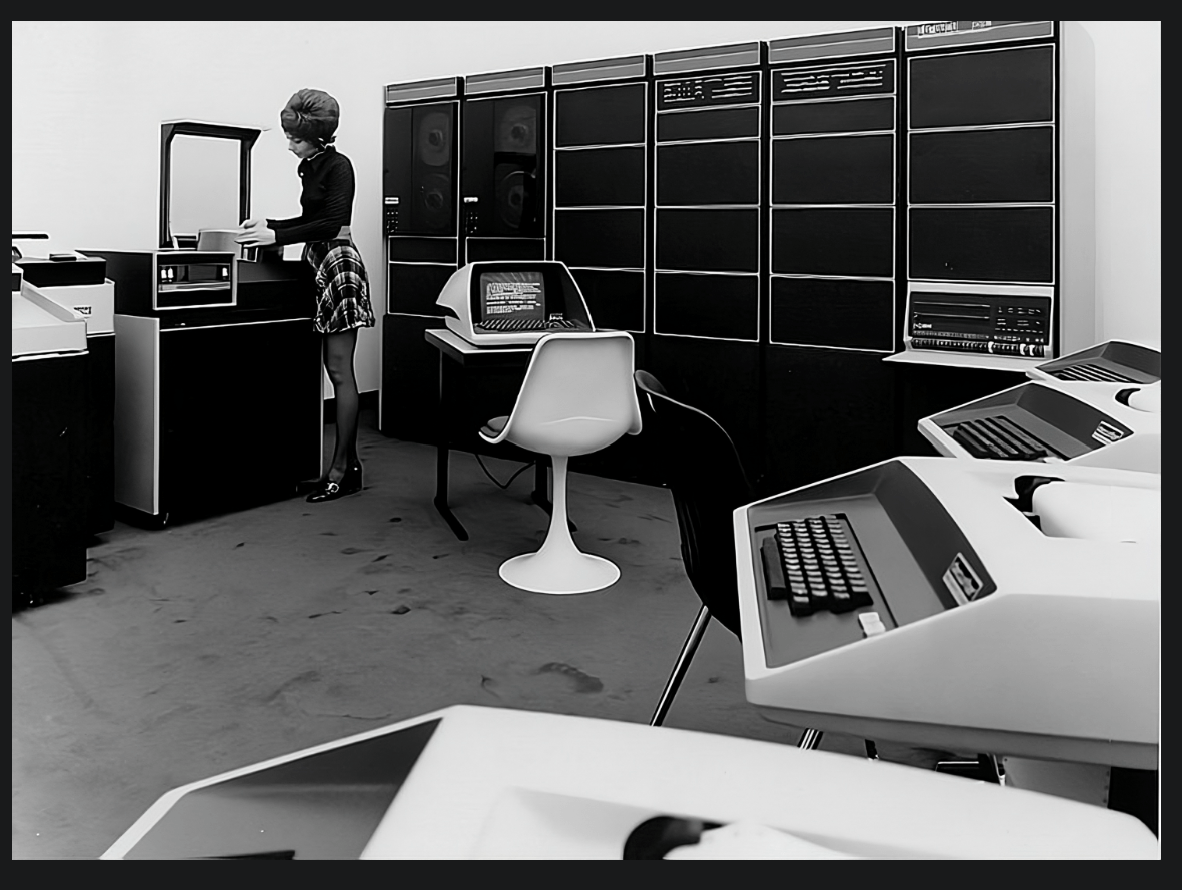
So time to rethink the project. This time I would go older–back to the 1970s for a terminal. There were many designs out there and I eventually settled on the DEC VT-05 from 1970, which was about the swoopiest of them all and I think the first terminal that included and integrated video screen.
Once I found this publicity photo from DEC I knew I would have to get the tulip chair as well once the terminal was ready.
At first I thought I could use the large 3D printer at IBiB to print the outer shell (including the black insert) in a single go but that proved unworkable. So I had to start building it up in pieces and then spent too much quality time gluing, sanding, plastering, sanding, plastering, priming, sanding, painting, sanding, coating, etc.
The shell is scaled down from the original, especially in depth. I found what passes for a “mechanical” keyboard these days (if only the younger generation knew) that fit well and disassembled a 12″ LCD security monitor to use as a display.
Running the same text based adventure game as the old laptop, I took it to a recent makerfaire and turned the public loose on it. The repro tulip chair finally arrived the day before the faire. It went over well. Next I will be expanding the repertoire of text games and activities people can play on it.
After a little over a year on the mini sumo robot project at It Begins in Brockport we can claim considerable successes. This is a project I lead the development on at my community makerspace and was adopted and taken much further by BoB and others at the space.
The early chassis design and software went through significant improvement during testing at the space. We then started putting together kits to make available to members and the the public. We were able to make a small number (about 20) kits available at $30 each to cover the cost of materials. We supported builders through workshops and individual consulting.
The bots have battled at a wide number of events including demonstrations, maker faires, and other community events. We have held three full-on tournaments and the winners were definitely not the most experienced competitors. Every has enjoyed themselves and we have worked hard to keep the competition friendly with an emphasis on fun and learning.
The sumo bot program has turned out to be very appealing to libraries and BoB has been invited to give a series of demonstrations/presentations on them. We will continue to develop the program and probably will do a full round 2 of development before growing the program in 2026.
I’ve really enjoyed exhibiting at various Maker Faires and similar events over the years. It’s not only a great opportunity to engage people with the gadgets I make but to get some feedback on how they interact with them. I hope I have also been able to inspire some makers of all ages. Once I have them playing with something I work to involve them with a conversation about their interests and what they like to make. Kids are easy. Adults are hard. Why do we forget to play and create?
Syracuse Maker Faire is a relatively young event but has been a very successful one due to its excellent leadership. I have been fortunate to not only be an exhibitor a the Faire but also to be part of the planning committee over three years. I have tried to contribute from out of town while continuing to learn about how these events are customized to each locality and planning group.
The 2025 event was another winner and I had a great time with all the people dropping by my booth. I look forward to the 2026 event and am already starting on some new projects for it.
I was asked to design and construct Santa’s ”naughty or nice” device to entertain families during the holiday season. Due to unexplained forces I think all young children will be judged “nice” after the machine checks the list and checks it twice. Adults will be at serious risk, however. At this point the hardware is ready save for the acrylic palm rest for scanning. My friend BoB will do the software and provided fresh muffins and a quick game of Fyra at the handover.
I have begun teaching a monthly workshop on adding lighting to projects (of all sorts, from woodworking to cosplay) at the Rochester Makerspace. Notes and other content will be posted to the course page.
It’s a short story in the virtual novel format (although definitely not with the typical subject matter for that genre). The primary thing that got me interested in doing this was using AI to help create art for a game experience. I initially was planning to create a board game with these characters and this plot, but realized I had no ability to create the required art work. The further I got into the project, the more it gravitated away from a board game toward a more scripted narrative with options (I have more experience with narratives than games anyway).
I used Scenario for the AI part. It was a lot like working with an uncooperative partner. I was able to get it to generate something that would work with a great deal of prompting and example images to work from. Making changes that were consistent was almost impossible. This work flow makes AI pretty much like a Photoshop filter at present. I hope things improve in terms of consistency and IP rights issues before I do another project like this.
Here is the description on Itch:
“A visual short story with interaction, Sargasso immerses you in a stranding afloat on the mysterious Sargasso Sea with three potentially dangerous characters onboard. There may or may not be a monster in the seaweed. Your only goal is to survive.
This game will play full screen in your web browser. As with other browser based games, there may be a brief delay as screens load.
The title screen of Sargasso contains a button for full playing instructions. Save at decision points for a full play-through, which takes about 20 minutes.
Sargasso plays on phone browsers, although it is not optimized for them. In order to speed up loading there is no sound in the current version.
This visual short story was created primarily as a test for the tools and workflow used, including using generative AI as one part of the workflow for the images.”
The Vortex Cannon I built with a colleague at IBiB. was a big hit a the Rochester Makerfaire. Or, I guess it should be a big puff.
Some slow-mo action:
It was fun blasting out fog rings. However we discovered that if you pump it very slowly the rings will just hang in the air for an extremely long time. Makes me wonder if there is a good way to light them up while their just hanging there….
More improvements to come, the next event will be the Syracuse Makerfaire.
Looking for a quick and fun project recently, I came upon the 3D printed Snap-Together Marble Maze that ericman314 posted to Printables
I had a wooden version of this toy when I was young and it was one of my favorites.
Making these things is never as simple as they seem like they will be. I broke several of the components from his design before I fundamentally redesigned all the parts to be more robust. I also deleted his maze and constructed one of my own that is significantly more complex.
I have included a zip file with all the 3D printable components. If you want to make one of these you will need to print 1 each of the base and the maze (either the finished maze or, even, better open the blank maze in a CAD program and design your own) and 2 each of the cams, knobs, and linkages.
The base, cams, linkages need to be printed in something more flexible than PLA (I used PETG) so the snap fittings don’t break. The maze and the knobs work fine in PLA. See his original for assembly instructions.
I have a wide variety of projects under way. Here is a sample.
I am building and extending the ball balancer by Aaed Musa. So far I have replicated his design and begun to modify it for continuous and interactive use at maker show cases. The biggest change has been to add a remote selector for different patterns. I have also enhanced the air flow, made the patterns a bit more reliable, and changed the look somewhat. It is good enough for public showing for now. In the future I plan to make it more interactive with additional controls and find a more eye-catching base to put it in.
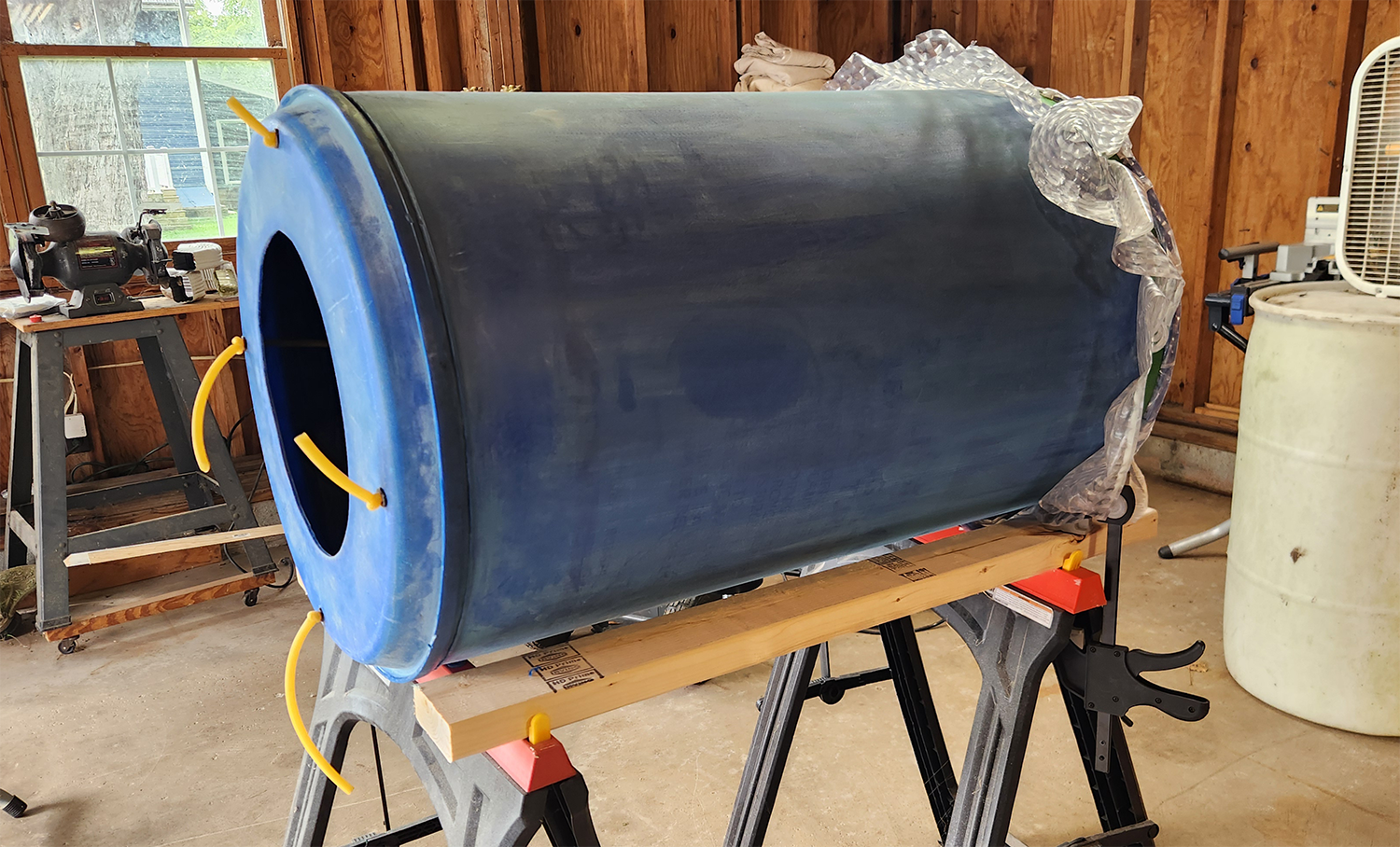
Slightly less finished is the Vortex cannon I am building with a friend. It’s based on a 55 gallon plastic barrel, so it is about 3 feet long and 2 feet in diameter. Although not shown in the picture, I have a basic tilt and swivel stand for it. He is going to clean up the look and we will take it to the next Maker Faire. We will shoot fog rings out of it with a party fogger. I hope we don’t set off the fire alarm and cause an evacuation!
Lastly (for now), I have been working on the idea of a kind of electronic pet–something that is between plant and animal like with some alien thrown in. I have mostly focused on the electronics but recently started playing around with the look. It’s going to need a translucent skin (so the inevitable blinky lights will show through). I picked up some soft, clear TPU to experiment with (it will probably be silicon in the final version). Once this stuff is off the 3D printer you can soften in an oven (about 370f) and re-texture it.
As these things get more finished I will put more details into project posts.
I am leading a project of the robot builders guild at my local makerspace (It Begins in Brockport) to create a Mini Sumo Robot league. We will be supporting builders wherever we find them and hosting events local to us.
In robot sumo two autonomous robots compete in a head-to-head match following the basic system of traditional human sumo matches. Robots are allowed no weapons, and are not allowed to intentionally flip each other. The sole purpose is a pushing match between the two robots to force the other from the arena.
The project is still in early stages as of the spring of 2024. However I have created a project page on this site that provides details, including complete plans and assembly instructions for a reference example from our IBiB2040 class of mini sumo bots.
We will be hosting exhibitions and competitions starting at the Syracuse Maker Faire in May, 2024. Anyone interested in our assistance to build bots or establish events in their area should get in touch with me at bill@tinkerfarm.net
Having taught workshops for a beginners on a variety of development platforms, from Arduino, to ESP32, BBC Micro:bit, and Raspberry Pi Pico, I have moved on to a new one for the next round of turning people on to physical computing. The Maker Pi RP2040 doesn’t have an elegant name, but it’s a great platform for learning and experimentation.
A box of learning in physical computing coming to a workshop near me.
The Maker Pi is very inexpensive, starting around $10 (through Newark). It has a RP2040 chip at its heart, so it can be programmed as a Raspberry Pi Pico. Thus no setup and easy Circuitpython or Micropython programming. It has onboard neopixels and a buzzer, a dual motor controller, user buttons, and breakouts for servos. It uses Grove connectors, which are much more secure than headers, but less permanent than soldering. The unit thoughtfully comes with 4 sets of Grove to jumper wire adapters, so you can use any commodity accessories as well as Grove-enabled ones. There are helpful status LEDs and on/off switches as well. You can power it with USB, Lipo (with a built in charger), or other power source using screw terminals.
It doesn’t have wireless communications but it is a cinch to add an external component for that.
I will be teaching a workshop on this board at the It Begins in Brockport maker space starting in October, 2023. I will post the workshop materials under the classes tab here once they are mature.
I’ve been involved with a lot of makerspaces in a lot of roles, but it is always fun to dive into a new one.
My current project is to help get It Begins in Brockport off the ground. It Begins in Brockport (IBiB.us) is a maker place in the making currently located in Hart Gallery 27 in Brockport, NY. Operated by Brockport Original Builds, a nonprofit organization committed to the enhancement of professional development and creative play through digital technology, IBiB’s mission is to empower community innovation and learning through accessible digital fabrication.
I have been asked to join the board of Brockport Original Builds and am actively working with the crew at IBiB to get the organization up and running.
We held a preview event in early May, 2023 and started programming and memberships in June.
I recently completed this wall decoration for the lobby area of the Shore Foundation. Shore provides refurbished computers to non-profit organizations and recycles/reuses/recovers material from the computing equipment that is not up to standards. I volunteer there on a regular basis and we get a lot of old hard drives that have no real value (plus we are obliged to destroy them by the equipment donor). So here is one way to use them.
That’s 96 hard drives in various states of disassembly. These are usually taken all the way down to individual components for resource recovery. We have recently acquired access to a x-ray fluorescence machine and its pretty amazing to see how many metals are actually in some of the small parts.
Instead of XRF analysis I just needed lots of steel wire and some spacers to put this together. Since the strands are hanging from wire the shiny discs cause moving reflections when something brushes the front of this display. Which will be pretty cool until the wires break and the strand falls on someone’s foot.
After finishing my first table top game (Planetary Profiteers), I felt compelled to roll on into a second. I really wanted a cooperative game and I wanted to do something with a board that players move pawns through.
The experience with Profiteers has taught me that you really have to monitor costs on low production games using a service like The Game Crafter. The box alone for that one is $12. The high costs are, of course, a matter of tiny print-on-demand production runs.
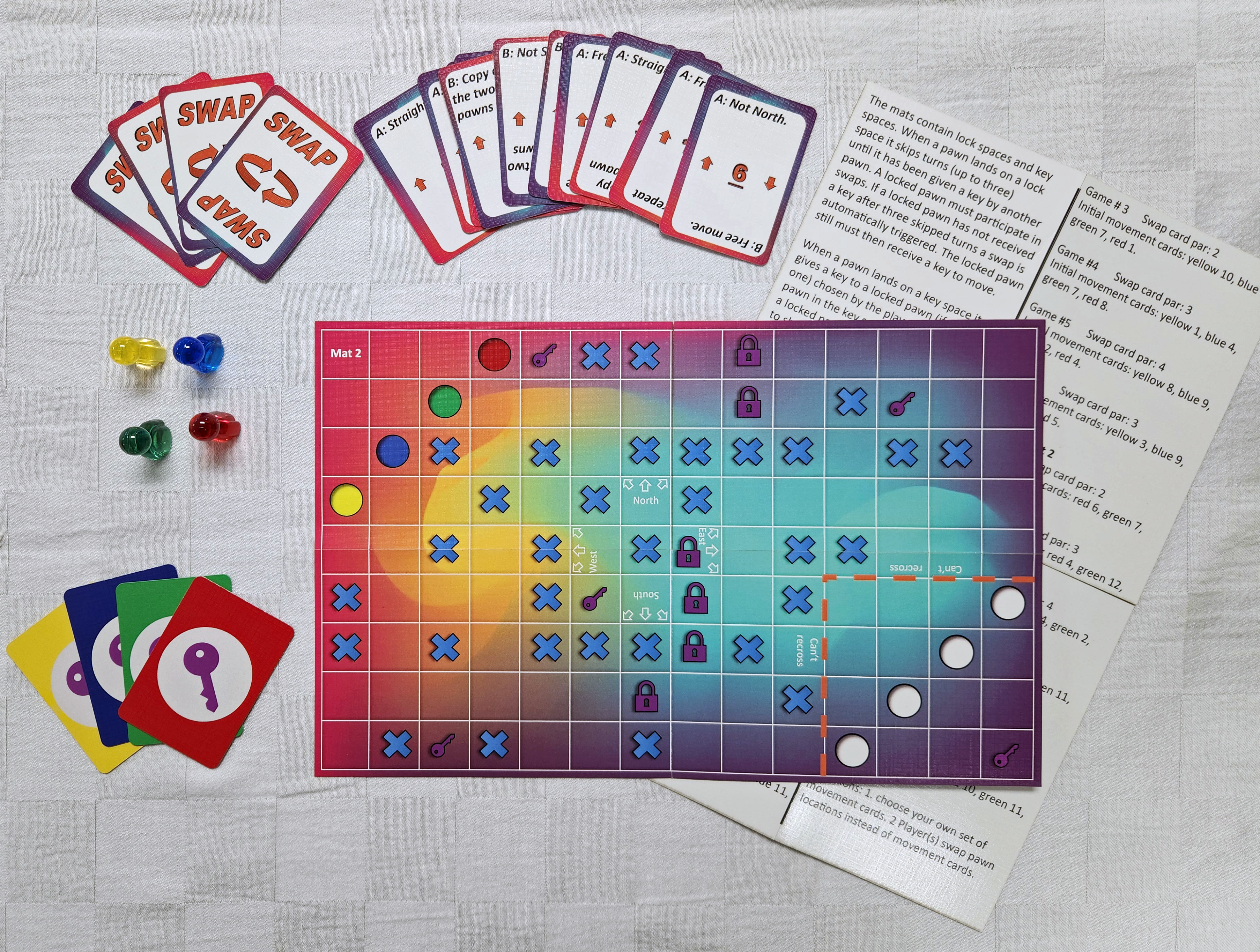
The new game, named LockSwap, aims to get the most out of a limited set of materials in a board-based cooperative game. It will be available on The Game Crafter after some final play testing.
I feel like it has accomplished my goal of a playable cooperative board game. It also plays extremely well with a single player, although there is a lot to keep track of!
Of course it didn’t spring into existence looking like the above. This game required a huge number of trial runs to set up a well functioning set of instruction cards, creating a pair of challenging mazes, and, mostly, setting the challenge (via a par system) for each variation. I’m still sorting out that last one and play testing finishes up.
After about a year of teaching an introduction to microcontrollers class using the Pi Pico I thought I would share all my workshop materials online. They can be found here.
The final version of the game is done. It’s on a crowd sale (the more orders, the cheaper the final price) until May 9, 2022. After that it will be available at thegamecrafter.com for single orders at the regular price
The pandemic has led us all in different directions. I found myself developing an unexpected interest in creating a table top game — unexpected because I rarely play them. But like other maker projects, working though the stages of creation, testing, revision, and production are alluring.
At this point the game is completing the play testing phase and nearing being made available to the public in a crowd funding campaign. I will make an updated post when it is available.
Like most DIY projects I wanted to make something that I would enjoy. As someone who doesn’t enjoy unnecessary competition I wanted it to be a cooperative game where a team had to work together to solve a problem, and where team leadership rotated. In this case the theme was a space mission where the team had to negotiate with planets to join their confederation. What each planet needed to agree would be a puzzle to be solved and team members had to put together offers from hands of drawn cards.
The first physical prototype was stickers with some rudimentary clip art attached to poker cards (hard to shuffle!) and folded “planetary packets” that players would open the leaves of as they made offers in a series of rounds.
Making a physical manifestation of the concept as quickly and cheaply as possible.
The first attempt at a play through (with friends) and some further reflection brought out three big problems.
I was definitely in over my head in trying to make a cooperative game the first time out. Something mildly competitive would be a must safer bet.
The planetary packets would be a nightmare. I would have to come up with a separate detailed and multilayered puzzle for each, and there would need to be a lot of them to keep the game fresh through several play-throughs. Moreover, there would be no way to get them professionally printed at a reasonable cost. They were essentially square envelopes with no glue and printed on both sides. I needed another way to bring variety to the playing experience.
I had no idea of how often a player would have a winning offer in their hand.
I tried to deal with the last by coming up with ways of calculating the odds of different hands using random number generators and math simulations but wasn’t very successful. I know many people use Tabletop Simulator to collect this kind of data but I didn’t feel the game was developed enough to be worth making a TTS version of it at this point.
Trying to hand calculate the odds of hands.
Version 2 of the game addressed the first two issues. Now players competed for points but the game still required collaboration. It would take minor iterations of version 2 and version 3 to find a good balance between cooperation and competition. Secondly, dice were introduced to set what planets needed to get in a successful offer. This meant one simple tile could be printed for each planet and the dice would introduce sufficient variability.
Version 2 was still a handmade affair but with some ideas for the overall look that would be refined as it went forward. Limited play testing with several groups showed that it was a viable game as well as some areas that needed improvement.
Upping the look while still making prototypes by hand.
As I moved forward with the third major version, I spent time viewing many play-throughs and reading reviews of popular card and dice games for guidance.
I also began researching short run printing houses for games and considering how I would bring a small run of the game into the market. Although there are several companies that will do this, I decided on The Game Crafter to print prototypes. Their capabilities and products also constrained (in a good way at this point) my options for producing a marketable project.
I purchased six prototypes of version 3 via The Game Crafter, with the game now titled Planetary Profiteers. These were sent out for more extensive play testing to distant contacts for honest feedback. The feedback is still coming in at this point but it has been useful enough for small and (hopefully final) revisions and positive enough for me to move forward with plans to finish this up and get it out there.
Planetary Profiteers in its penultimate (?) form for extended play testing.
A final lesson I have learned so far is to start on the next one before the first one is done. I am in a bit of a lull as play testers take their time to get back to me and I am waiting on some new printed copies from Game Crafter. So in the meantime I am on to a paper and pencil test of an idea for a social puzzle. This one will be cooperative and less conventional.